
- AGS
- FR
- Actualités
-
Partager cette page
Genital Modifications and Moral Boundary-making: Medical Perspectives on FGM/C versus FGCS in Belgium and the Netherlands
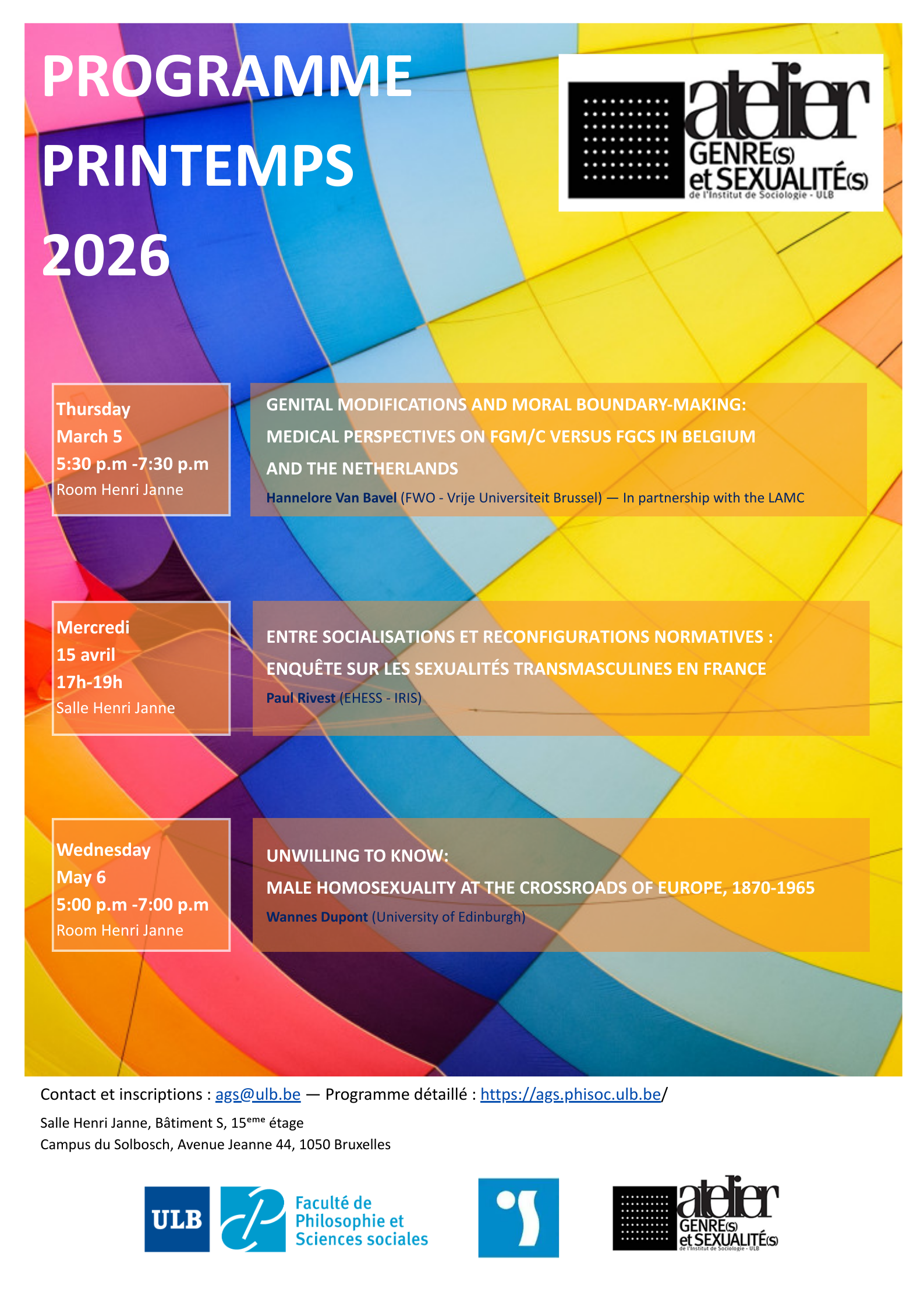
On Thursday, March 5th (from 5:30 pm to 7:30 pm), l'Atelier Genre(s) et Sexualité(s) is pleased to welcome you to a lecture by Hannelore Van Bavel (FWO – Vrije Universiteit Brussel), in partnership with the LAMC, as part of the AGS Spring 2026 Seminar program, entitled: ‘Genital modifications and moral boundary making: Medical perspectives on FGM/C versus FGCS in Belgium and the Netherlands’. This event will take place at the Université Libre de Bruxelles, Solbosch Campus, in the Henri Janne room, on the 15th floor of Building S. Participation is free of charge, but registration is required to secure your spot at the following email address: ags@ulb.be.”
Abstract: This chapter explores how medical professionals who perform female genital cosmetic surgery (FGCS) in Belgium and the Netherlands perceive and differentiate between female genital mutilation/cutting (FGM/C) and FGCS. While FGM/C is criminalised in both countries, FGCS is not, even though many FGCS procedures technically fall within the definition of FGM/C. In 2008, Dutch professional societies attempted to clarify this distinction but failed to provide concrete criteria, instead relying on what was framed as a self-evident moral boundary. As a result, individual clinicians are left to determine where FGM/C ends and FGCS begins.Drawing on interviews with healthcare professionals, the chapter examines how this boundary is constructed in everyday practice. It asks how clinicians understand and differentiate between FGM/C and FGCS, whether they see the practices as distinct or overlapping, and what forms of reasoning they draw upon in doing so. The analysis shows that clinicians primarily rely on the ethical concepts of harm and autonomy, but that these are interpreted through implicit cultural assumptions. In practice, FGCS is framed as an autonomous, legitimate medical choice, while FGM/C is constructed as inherently harmful and coercive. These distinctions are not neutral: they reflect and reproduce racialised moral hierarchies, through which medicine actively participates in defining whose bodily practices are recognised as acceptable and whose are not.
Biography: Dr Hannelore Van Bavel is a postdoctoral researcher at RHEA Research Centre for Gender, Diversity, and Intersectionality (VUB), with an interdisciplinary background in social anthropology (PhD), sociology (MSc), gender and diversity studies (MA), and currently pursuing a MSc in Sexology. Her research examines why societies across time and place modify genitalia, and why different forms of genital modification provoke such different moral and legal responses. More specifically, she studies the contrasting treatment of female genital mutilation/cutting (FGM/C) and female genital cosmetic surgery (FGCS), and what this reveals about the intersections of gender, race, class, culture, and coloniality. Her current project explores FGCS in Kenya, with attention to the increasingly blurred boundaries between FGCS and medicalised FGM/C.
Room Henri Janne, Building S, 15th floor – Avenue Jeanne 44, 1050 Bruxelles